Holy Trinity Church, Hethe — exterior, from south (August 2025)
An introduction to the history and records of the church and its graveyard
This website, focused on Holy Trinity Catholic Church, Hethe, aims to:
This page outlines the origins of the Catholic parish of Hethe, explores the creation of its new church in 1832, and introduces the records of it sacraments and burial ground, as well as explaining Hethe's links to Souldern.
Holy Trinity Church, Hethe — exterior, from south (August 2025)
Click or tap the panels below for more information on the history and records of Holy Trinity Church, Hethe.
Holy Trinity Catholic Church is sited in Hardwick Road, on the western fringes of the village of Hethe.
Click or tap thumbnail below to view a larger image

Holy Trinity Church, Hethe - exterior, view northwards from Hardwick Road (August 2025)
Given the new patronage of the Catholic parish of Bicester and Hethe from January 2026, dedicated to Saint Edmund Campion, it is appropriate to begin this account of the parish's origins by reflecting briefly on the importance of Campion and other Jesuit priests to local Catholic continuity, through their nurturing of the Catholic faith in the Thames Valley — ministering to the spiritual needs of the lay faithful, often in secret, and at a time of extreme peril and personal cost.


Like other priests of the English College in Douai, who joined the Jesuit mission to England, Campion was committed to preach and administer the sacraments in a territory where it was now illegal to do so, following the 1559 Acts of Uniformity and Supremacy. No detailed itinerary of his journey survives but, during his mission of summer 1580, Campion must have visited around 60 gentry and noble houses in Berkshire, Buckinghamshire and Oxfordshire (Hodgetts, 2010, p. 29). Enabled by the courage, cooperation and protection of the families involved, Campion used these houses to say mass and to preach, drawing eager congregations of Catholics from the surrounding countryside.
As an ordained priest, Campion was not alone in his mission across the three counties, himself remarking (in November 1580) that "we are well assisted by priests, whom we find in every place, whereby the people is well served and we much eased in our charge" (Hodgetts, 2010, p. 38). It may even be the case that Campion needed to fit in with an existing rota of priestly duties.
That multiple priests were active in the area is clear: in Bicester, for example, the Elizabethan State Papers of 1583/4 record the harbouring of six Jesuit priests or 'seminarists' (Stapleton, 1906, p.1); while in Godington, also part of the Fermor estate, and well off the beaten track, all four of the village farms entertained priests (Stapleton, 1906, p. 106). The 1580s as a whole witnessed intense and continued missionary activity by foreign-trained (but often English-born) Jesuit priests, including George Nichols and his companion, Richard Yaxley, who were executed at Holywell, Oxford, in 1589 (Hodgetts, 2010, p. 38).
Click or tap the thumbnail below to view whole map

Christophorus Saxton, Oxonii, Buckinghamiae et Berceriae comitatuum, 1574 — Christopher Saxton's map of Berkshire, Buckinghamshire and Oxfordshire is contemporary with Campion's English mission. Its decorative border is embellished with the Elizabethan royal coat of arms, emphasising within whose jurisdiction he now travelled, and naming the power and authority which threatened his integrity.
Returning our focus to the district around Hethe, the village sat in a landscape where the Fermor family held substantial estates, running from Godington in the east to Idbury in the west, and centred particularly around Somerton and Hardwick.
Given the local importance of the Fermors in underwriting the Catholic cause in north-east Oxfordshire, Campion seems likely to have been harboured at the family seat of Somerton Manor in the summer of 1580 (Hodgetts, 2010, p.39), even though Thomas Fermor (1523-1580) died in August and his wife, Bridget, died in June that year (Farmer, 2026).
Click or tap the thumbnail below to view large image

The elaborate alabaster chest tomb of Thomas Fermor (d.1580) and his wife Bridget — in the Fermor Chapel, St James's Church, Somerton. Their four children (one deceased) are represented by the figures on the front face.

The Fermor Chapel, St James's Church, Somerton.

Somerton Manor — ruins of the Manor House built for William Fermor, Thomas's uncle, after 1512. (Pen-and-ink drawing from: Alfred Beesley's extra illustrated copy of his History of Banbury, 1840s). Some sources suggest this ruin is the remains of the domestic chapel, but Stapleton (1906) and Oxfordshire Historic Environment Record have it as the window of the large hall of the manor house.
In July 1581 Campion was arrested at Lyford Grange, north of Wantage. His subsequent trial in November, and execution on 1 December 1581, saw him martyred for his faithful service and missionary zeal, and over the centuries that have followed, his sacrifice has inspired many. The witness of Jesuit priest-martyrs like Campion, in the 16th century, and the gentry lay faithful who supported them, helped preserve the foundations of English Catholicism through and beyond the Protestant Reformation, ensuring its survival until the lifting of penal restrictions between 1778 and 1844, ultimately giving rise to its 'second spring' in the latter half of the 19th century. Edmund Campion was among The Forty Martyrs of England and Wales to be canonised by Pope Paul VI in 1970.

Portrait of Edmund Campion, knife in chest, against a backdrop of his execution, 1581. (Engraving by Johann Martin Lerch, 1631).
In 1606 Sir Richard Fermor (bef. 1580-1642/3) bought the medieval manor house at Tusmore (Lobel, 1959, p.336), which was soon to become the family's principal seat. Sir Richard's second son and heir, Henry Fermor (c.1610-1673), moved to Tusmore either before (Lobel, 1959, p.293), or not until, his father's death in 1642/3 (Stapleton, 1906, pp. 69, 74). The Fermors may have rebuilt and enlarged the house at Tusmore and added a domestic chapel, or possibly it was an already existing medieval chapel which attracted them to the house.
The Fermors kept a resident chaplain (Stapleton, 1906, pp.90-94), the first being Antoine le Grand (a Franciscan) in around 1695, with later appointments mostly drawn from the Jesuits. The chaplaincy served both the family and the Catholic farming communities which were sustained by Fermor employment and residence, across their estates in Godington, Hethe, Hardwick, Tusmore, Fritwell and Somerton. That Catholicism survived the Reformation in these parts of north-east Oxfordshire is therefore largely due to the patronage and steadfastness of the Fermor family.

William Fermor, senior (1737–1806). (Oil portrait by Anton Raphael Mengs, 1757).
In a later generation, William Fermor (1737–1806) of Tusmore was a significant mover in steering parliamentary efforts towards the Second Roman Catholic Relief Act of 1791, which relieved Catholics of certain civil and religious penalties.
Tusmore House, the seat of the Fermor family, was rebuilt in the classical style, and the park remodelled, in the period 1766-79 — view description at www.lostheritage.org.uk. During this time the free-standing family chapel was redecorated and became temporarily inaccessible to local Catholics. But mass at Tusmore soon resumed, to the benefit of household staff and estate workers, and continued until 1810 when William Fermor junior (1771-1828) moved out of the house, letting it out to Protestant tenants.
Click or tap thumbnails below to view a larger image

Tusmore House, 1840-1860

Tusmore House, 1941
Across the district, more capacity for worship was needed than the Tusmore chapel could alone provide, and this was available at Hardwick Manor House, also part of the Fermor estate — view description at www.heritagegateway.org.uk. The Manor House's attic chapel had been in use since at least the era of persecution (1580-1625) and, by the 1730s, was increasingly relied upon by the local Catholic population. When William (junior) moved out of Tusmore in 1810, the chapel furniture was transferred to Hardwick Manor House.
Click or tap thumbnail below to view a larger image
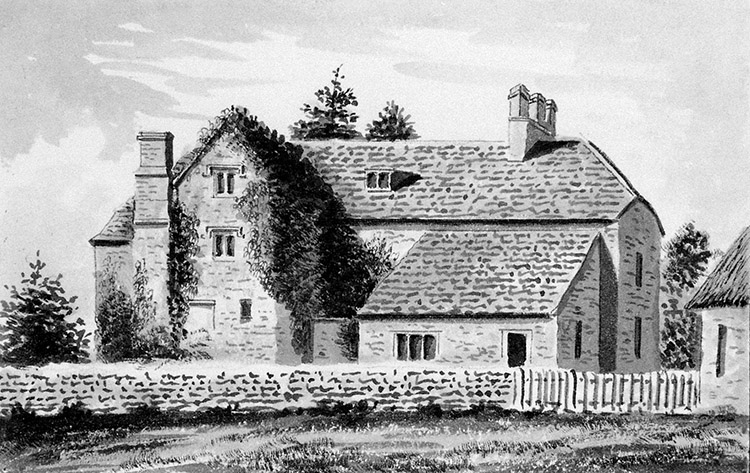
'Hardwick Manor House' — rear elevation. (Drawing from: Alfred Beesley's extra illustrated copy of his History of Banbury, 1840s).

Hardwick Manor Farm, Hethe Road, Hardwick — front elevation, (December 2025).
Also in 1810, the Reverend Samuel Corbishley took charge of the Hardwick-Tusmore Mission, living at Hardwick. On his arrival in September, he decried the current state of record-keeping, and proceeded with zeal to take a census of the Catholic population across the whole district, for the better exercise of his mission.
Click or tap thumbnail below to view whole image

Samuel Corbishley's foreword, 1810 (First Hethe / Hardwick-Tusmore register).
Corbishley served the Hardwick-Tusmore congregation until his death on Christmas Day 1830. He was interred at the Church of St John the Evangelist, Banbury, where his memorial plaque can be seen on the west wall.

Memorial plaque to Samuel Corbishley (1759-1830) — Church of St John the Evangelist, Banbury
William Fermor (junior) died in 1828, marking the end of the Fermor male line of Tusmore, and the estate was inherited by (Anglican) Captain John Turner Ramsay of Croughton, at which point the Catholic chaplaincy of Tusmore became extinct and Catholics were no longer welcome to worship on the estate, including at the Hardwick Manor House chapel. Hereafter, mass was said from house to house in Hethe and Hardwick.
Ramsay's attitude to the local Catholic population was clearly still antagonistic in August 1839 when he distributed a public notice, requiring the attendance of Hardwick residents at St Mary's (Anglican) Church, under pain of eviction for non-compliance.

Bucks Gazette and Aylesbury News, 18 September 1839, page 7

St Mary's Church, Hardwick — exterior, from the south-east
A new mission priest, Father Alfred Maguire, was appointed within a week of Corbishley's death at Christmas 1830, and promptly purchased a piece of ground lying between Tusmore and Hethe, with the next year spent constructing a new chapel. Maguire published a heartfelt national appeal for funds to build a Catholic chapel at Hethe in the 1832 edition of the Catholic Directory, although £500 of the £800 building cost was paid for by a Mrs Jennings of Somerton (Grant, 2000, p. 34-35) – presumably Catherine Jennings née Collingridge (buried in plot D2). The new Holy Trinity Church, Hethe, was opened on 22 May 1832, by that stage sorely needed by local Catholics.
Local newspaper titles were few in number until the 1840s, and none of the extant county newspapers of 1832 (Jackson's Oxford Journal, Bucks Gazette, Northampton Mercury) managed to cover this momentous event in local Catholic history. However, James C. Blomfield, local historian and Rector of Launton, writing in the 1890s, describes how the Hethe appeal and opening were reported in a contemporary issue of the Catholic Magazine:
Click or tap thumbnail below to view whole image

J.C. Blomfield, History of the present deanery of Bicester, Oxon. Volume 5: Fringford, Hethe, Mixbury, Newton Purcell and Shelswell (c. 1892) — pages 37-38
Hethe's was the fourth new Catholic place of worship in the county following the Second Catholic Relief Act of 1791. Only Catholic chapels at Mapledurham House, at St Clement's Street, Oxford (Chapel of St Ignatius), and at Old Heythrop (St Mary's Church), pre-date Hethe.
But under the 1791 Act, all Catholics were still required to register their place of worship, and the name of their priest, with the local magistrate (Quarter Sessions). A registration certificate of 1839, signed by parish priest, Father Alfred Maguire, for the then relatively new chapel at Hethe, survives in Oxfordshire History Centre collections — reference QS1839/2/A12/4:
Click or tap thumbnail below to view whole image

Certificate for the Catholic Chapel of the Blessed Trinity, Hethe — Oxfordshire Quarter Sessions, 9 April 1839.
Alfred Maguire crossed paths again with the justices of the County Quarter Sessions in 1842 — reference QS1842/2/A7/11. Father Maguire was reported to the Easter 1842 session, presumably by the churchwardens of the (Anglican) Church of St Edmund and St George, Hethe, for non-payment of church rates. Until abolished by an Act of 1868, such rates were a mandatory local tax levied on all occupiers of land or houses, for the upkeep of the physical fabric of the (Anglican) parish church.
At that session, the justices issued a 'distress warrant', to recover Fr. Maguire's debt of three shillings and ninepence church rate, plus court costs of 15 shillings! If necessary, the warrant would have authorised the constables to enter his property and 'distrain' or seize personal goods. Although Catholic and Nonconformist ministers were sometimes known to practise a policy of non-cooperation, we have no evidence to conclude whether Fr. Maguire's non-payment was deliberate protest or simple lack of organisation.
Click or tap thumbnail below to view whole image
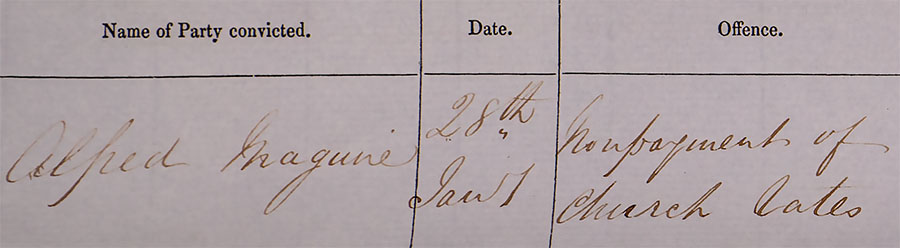
Fr. Alfred Maguire's penalty for non-payment of church rate — Oxfordshire Quarter Sessions, Easter 1842.

A plot of land for a new graveyard, adjoining Holy Trinity Church on its east side, was acquired a few years after the chapel opened, with the first burial taking place on 29 February 1836.

Holy Trinity, Hethe, burial register, 29 February 1836: John Broadway
The deceased was John Broadway, aged 65, Surveyor to the Duke of Buckingham at Stowe, who suffered a fatal accident in the Duke's library, as reported in the Bucks Gazette newspaper:

Death of John Broadway, Bucks Gazette, 5 March 1836, page 4
John Broadway's gravestone was recorded in Lewis Chambers' 1917 survey of Hethe churchyard, but may not be the earliest inscription, as it may have been erected after the later deaths of his wife (1880) and son (1851).
Click or tap thumbnails below to view a larger image

Gravestone of Broadway family: John (1836), Martha (1880), and Alexander (1851)

1917 transcript of graveyard inscriptions — entry no. 78, Broadway family
All images in this section are zoomable – click or tap thumbnail below to view the whole or large version of any image
There was an integral relationship between Hethe and Souldern, as there was across all the Catholic communities in north-east Oxfordshire . Souldern remained a Catholic stronghold after the Reformation through the loyalties of the lords of the manor (Lobel, 1959, p. 311). An attic chapel at Souldern House (now called Souldern Manor), with priest's hiding place, was in use until 1781 when the incumbent lord of the manor, Samuel Cox, died, resulting in the closure of the chapel and removal of the sacred vessels and vestments to a place of safety (Stapleton, 1906, p.104 and Gough, 1882, pp.46-47).

In the ensuing years, the faithful had to travel to Hardwick and Hethe to hear mass, that is until 1852, when the chapel was brought into use again by Souldern House's new lessee, the local physician, Dr John Thomas Dolman. Also in 1852, the Trustees of Samuel Cox granted £50 a year for mass to be said at Souldern – this revived mission was served by Fr Joseph Robson (priest of the Hethe Mission from 1847 until his early death in September 1870), and he was the beneficiary of this stipend, thereby serving both Hethe and Souldern chapels.
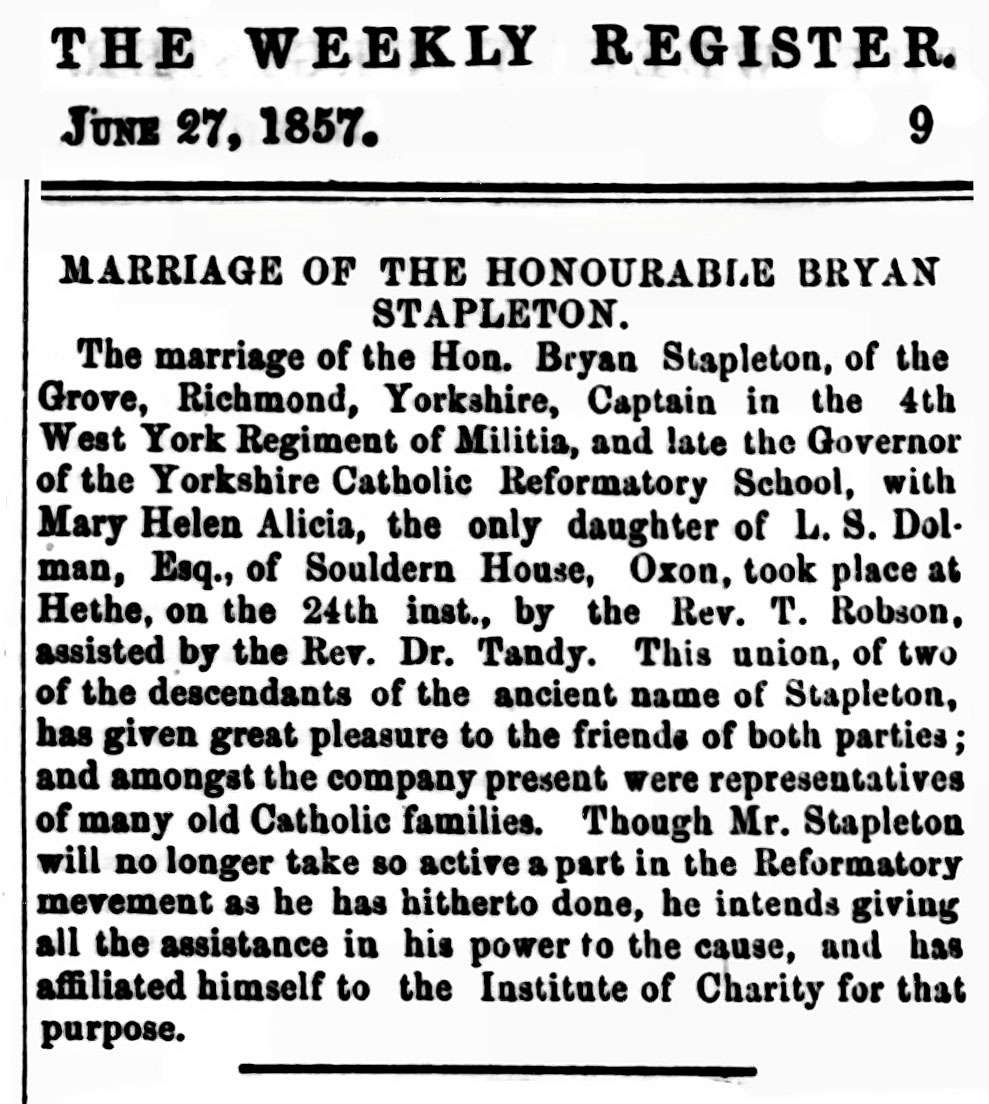
Dr Dolman died in 1867, and was buried in Holy Trinity graveyard, Hethe. In 1868, Dolman's son-in-law, Captain The Honourable Bryan John Stapleton (also buried at Hethe), took the lease of Souldern House, and made arrangements to support a resident priest, while also ensuring that Fr Robson received a compensatory payment for the remainder of his life (Stapleton, 1906, p.104). Bryan Stapleton had earlier married Dolman's daughter, Mary Helen Alicia Dolman, known later in life for her published account of Catholic history in Oxfordshire.
In February 1870 a new chapel was opened at Souldern House. St Joseph's Chapel, conceived by Mrs Anne Helen Dolman as a memorial to her late husband, was built in the grounds of Souldern House, by adding a brick extension to the former the coach house (Gough, 1882, p.46-47). The opening ceremony took place on the Feast of Candlemas, and was attended both by an infirm Fr Joseph Robson (who died just a few months later) and his new young curate, Fr Philip Sweeny. The opening was described in local newspapers:


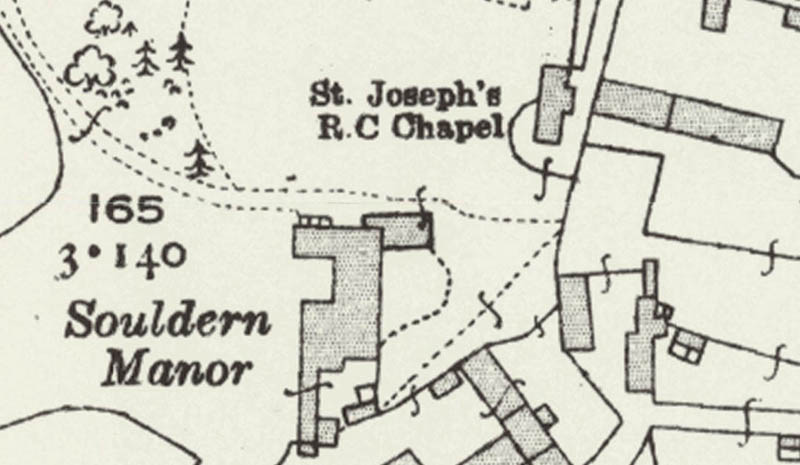
Following two short-lived incumbents, Fr Samuel Glossop was appointed to St Joseph's, Souldern, in January 1873, and was its longest serving priest, up until his death in March 1920. He is also buried at Hethe. Souldern remained a separate parish until the 1950s, when it was merged with Hethe once again, and St Joseph's Chapel remained in active use until about 1972, when the baptism register ceases (Grant, 2000, p.44).

St Joseph's Chapel is now part of a private domestic property. The square window leading suggests that the original stained glass windows are no longer present.
A single register volume survives for Souldern, covering baptisms only, and it seems appropriate that the first recorded baptism to take place, on 31 May 1870, was for Christopher Stapleton, son of the chapel's principal benefactor, Bryan John Stapleton.
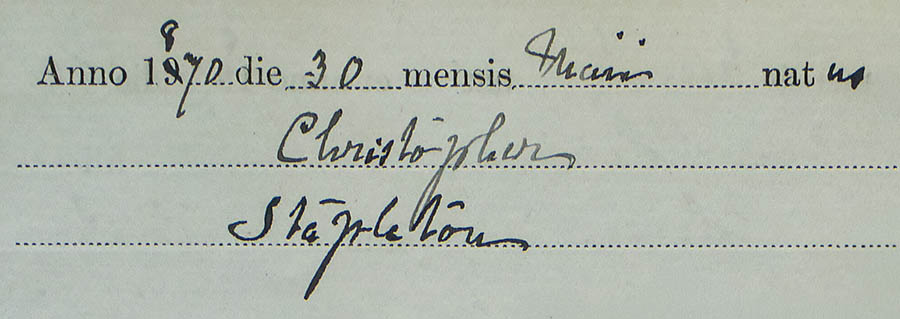
Historic registers for the Catholic parish of Hethe survive from 1809 onwards (baptisms), 1856 onwards (marriages), and 1836 onwards (burials); while an allied baptism register for the chapel at Souldern survives from 1870 onwards.
Click or tap thumbnail below to view whole image
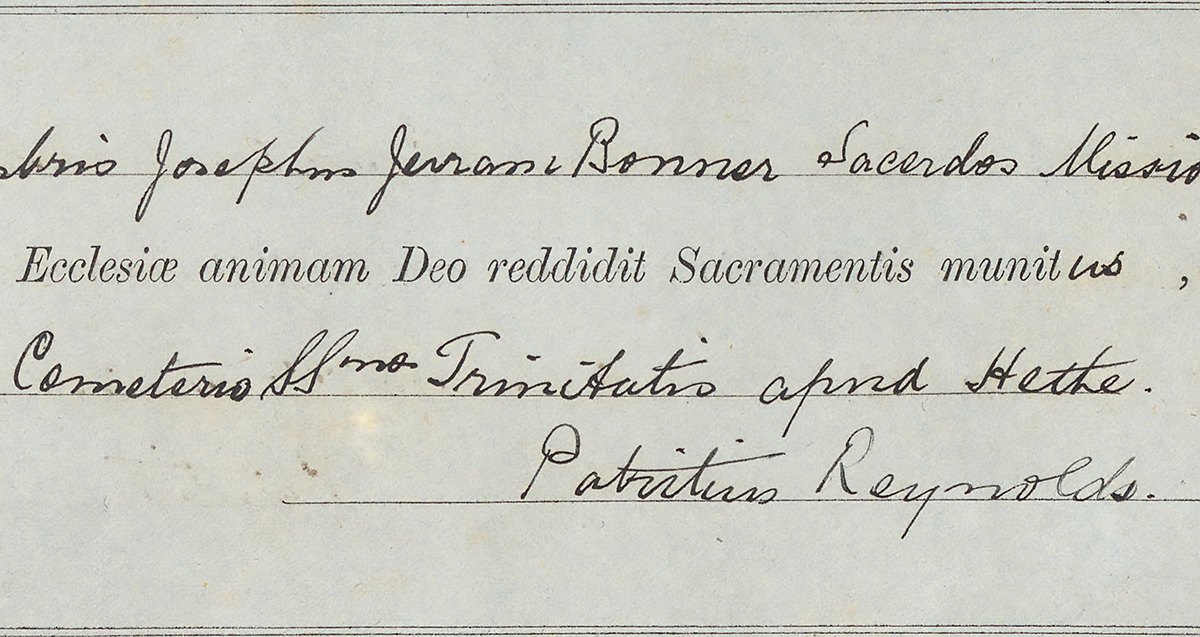
A survey (transcript) and digital interactive plan of memorials in the graveyard are available.
A range of historic manuscript sources record the monumental inscriptions in the graveyard at particular points in time:
Click or tap thumbnail below to view a larger image

Graves of three priests of the Hethe and Souldern Missions — Reverend Fathers Samuel Glossop, Joseph Bonner and James Wall
The registers of Hethe, Souldern and Bicester record Catholic families from a wide area around our focus parish of Hethe. Families from across north-east Oxfordshire, and into neighbouring parts of Buckinghamshire and Northamptonshire, were dependent on Holy Trinity Hethe (and, later, Souldern and Bicester) for access to the sacraments.
An interactive map of parishes, which make up the countryside around Hethe, lets you find the surnames associated with each place, and then search for instances of those surnames in the registers.

The historic photographs below of Holy Trinity Church, Hethe, are reproduced with the kind permission of:
Click or tap thumbnails below to view a larger image

Holy Trinity Church — west front (south side) and gateway to churchyard (sepia-tinted postcard, c. 1905-1912)
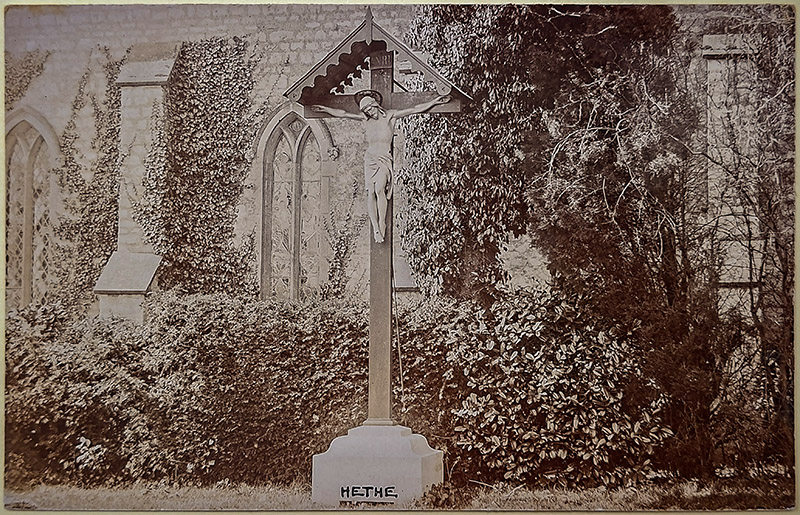
Holy Trinity Church — Calvary in churchyard, presented by Lord North in 1881 (sepia-tinted postcard, c. 1905-1912)
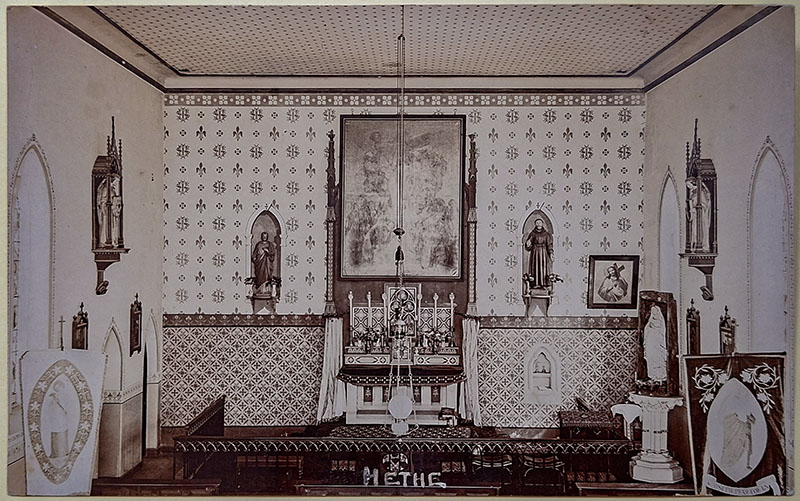
Holy Trinity Church — sanctuary (sepia-tinted postcard, c. 1905-1912)

Holy Trinity Church, Hethe — exterior, from south. (Photograph by A.W. Bowne, c.1960-1969).
Further study of available sources can provide more information on the Catholic history of Hethe, the Fermor family, and their geographical context of north-east Oxfordshire.
| Reference | Bibliographic Details |
|---|---|
| FARMER, 2026 | Philip Alan Farmer, 'The Fermor protection of Catholic recusants in Somerton', [blog post], 15 Feb 2026. |
| GOSLING, 1993 | Margaret Gosling, 'Berkshire and Oxfordshire Catholics and the Lenten Assize of 1588', Oxoniensia, vol 58 (1993), pages 253-262. (Oxfordshire Architectural and Historical Society: pdf, 1.4Mb). |
| GOUGH, 1882 | J.H. Gough and A.P. Gough, Notes on Souldern, Oxon, from the earliest period to the present time. (Bicester: George Hewiett, 1882). (Google Books: pdf, 2.1Mb). |
| GUILE, 2022 | Tim Guile, 'Somerton, Tusmore and the Fermors', Cake and Cockhorse, vol 24 (2022), pages 16-21. (Banbury Historical Society: pdf, 23Mb). |
| GUILE, 2023 | Tim Guile, 'Ember Burning, Catholic Recusancy and the Fermor Family of North Oxfordshire, (YouTube talk - English Catholic History Association, 24 January 2023, 56 mins). |
| GUILE, 2024 | Tim Guile, 'The Fermor family of North Oxfordshire, (Ecclesiastical History Society, [blog post], 16 December 2024). |
| GRANT, 2000 | Joy Grant, 'Hethe-with-Adderbury: the story of a Catholic parish in Oxfordshire' (Archdiocese of Birmingham Historical Commission, 2000). [Bibliographic reference only - not available online]. The most comprehensive modern account of the history of Holy Trinity, Hethe. |
| HADLAND, 2004 | Tony Hadland, Thames Valley Papists From Reformation to Emancipation 1534 - 1829 (Mapledurham 1997 Trust, 2004). (hadland.wordpress.com: pdf, 3.4Mb). |
| HODGETTS, 2010 | Michael Hodgetts, 'Campion in the Thames valley, 1580', Recusant History, vol 30, part 1 (2010), pages 26-46. [subscription required for online access] |
| LOBEL, 1959 | A History of the County of Oxford, Volume 6: Ploughley Hundred, ed. Mary D Lobel (Oxford University Press, 1959). This volume of the 'Victoria County History' series for Oxfordshire includes parish accounts for Hardwick (pp. 168-173), Hethe (pp. 174-181), Somerton (pp.290-301), Souldern (pp.301-312), and Tusmore (pp. 333-338). |
| SOMERTON, 2011 | The Fermor Family (Website preserving the research and writing of the Somerton Village History Project - first published online as The Fermors and Catholicism in Somerton, 2011). |
| STAPLETON, 1906 | Mrs Bryan Stapleton, 'A history of the post-reformation Catholic missions in Oxfordshire : with an account of the families connected with them', (Oxford University Press, 1906). (Internet Archive. pdf, 28Mb). Writing under her husband's name, Mary Helen Alicia Stapleton (née Dolman) produced the seminal work on Catholic history in the county. She covers the Hethe and Bicester mission on pages 85-95. Her husband, Bryan John Stapleton (1831-1903) is buried at Hethe – digital plan plot E2. |